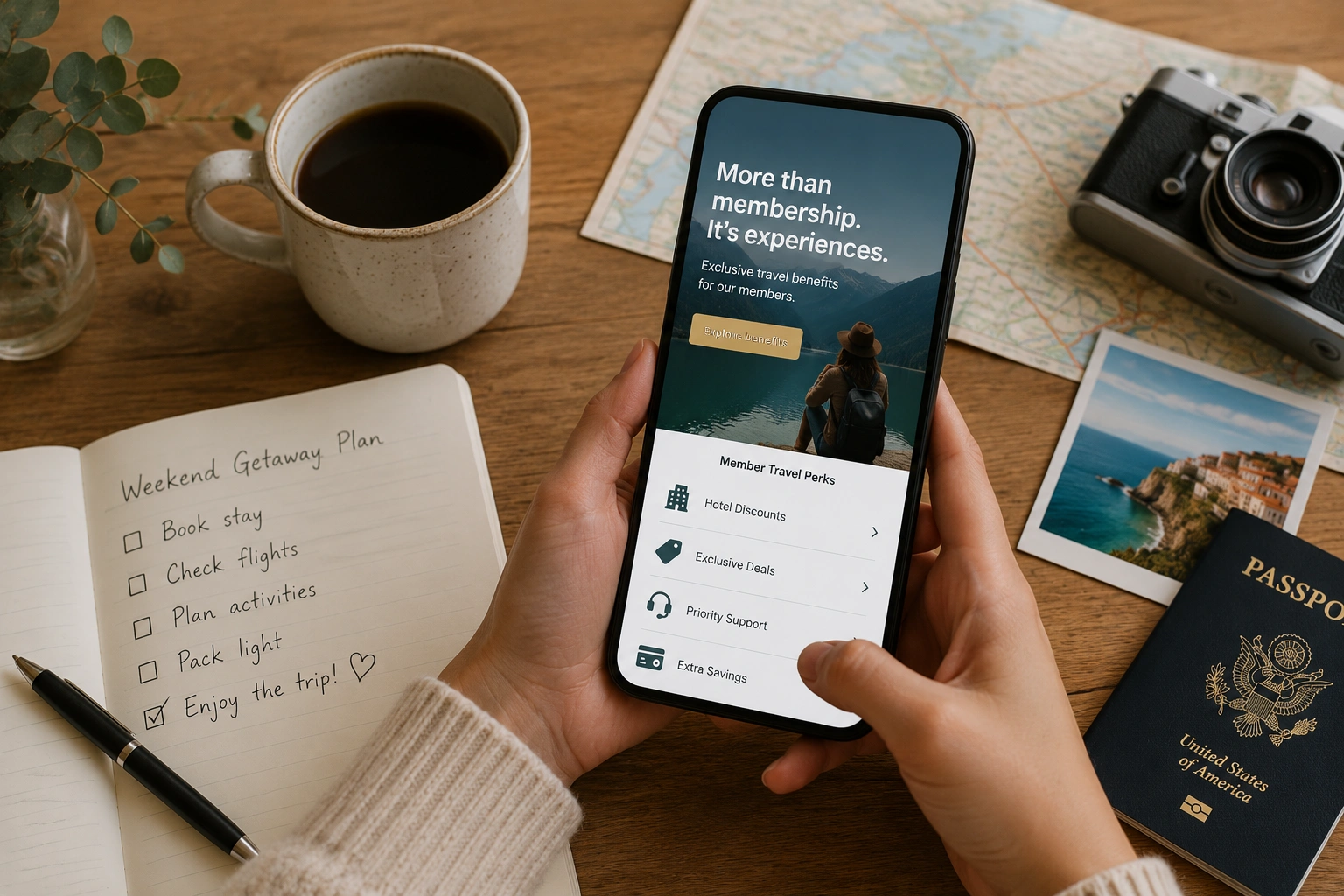
How to Reduce Customer Churn: 9 Tactics Ranked by ROI

Most subscription and membership operators have a churn number they want to move. The challenge is not running out of tactics — it’s choosing the right ones, in the right order, with limited team capacity.
This list ranks nine churn-reduction tactics by ROI, based on what actually moves the renewal number for subscription, membership, and loyalty operators in 2026. Tactic 1 is the most underused. Tactic 9 is essential but defensive. Read in order, then jump to the section on how to choose what to do first.
Note: this article assumes you already know what customer retention actually is and how to calculate it. If not, start there and come back.
1. Add experiential travel perks
Best for: subscription and membership operators whose retention curve plateaus after month 3, and whose existing points/discount program isn’t producing emotional loyalty.
Why it’s #1: travel perks produce discrete, memorable experiences — a hotel stay at a rate the member couldn’t find publicly, a cruise upgrade, a vacation rescued by member-only inventory. That changes the renewal question from “is this still worth what I’m paying?” to “when will I use this again?”
The behavioral data is striking. CBRE’s 2024 hotel loyalty report showed loyalty members accounted for 52.8% of all occupied rooms — up 2 percentage points year-over-year, when overall industry demand grew only 1.2%. Loyalty members delivered 12% more room nights YoY. Delta has reported a 30% engagement lift among frequent flyers in its loyalty program. The pattern: when members redeem travel, they engage more, stay longer, and spend more across the rest of the program.
The reason this is #1 by ROI is twofold: (a) it’s underused — most subscription operators haven’t built a travel benefit yet, so the competitive differentiation is real; and (b) it directly attacks month-four risk, the period when members start mentally re-evaluating the subscription. A member who redeems travel in month 2-3 enters month 4 in a completely different evaluation framework.
For the strategic context, see CTS’s earlier pieces on experiential travel in the subscription era and resort weeks as a new loyalty currency.
2. Redesign onboarding for the first 14 days
Best for: any subscription/membership business with a measurable month-1 churn cliff.
The first 14 days predict the next 14 months. A retention curve that breaks early almost always traces back to onboarding that didn’t deliver an “aha moment” — a clear, concrete proof that the membership is doing what it promised. If a member doesn’t experience value in the first two weeks, no amount of customer success outreach in month 4 will save the renewal.
Practical changes that move the number:
- Identify your single “value event” — the action that correlates most strongly with month-3 retention. Make onboarding singularly focused on getting members there fast.
- Email and in-app sequence aimed at the value event, not at “feature tours.”
- Remove friction from first use: skip account-setup steps, pre-populate, give members the shortest path to the benefit.
3. Build tier-based benefits
Best for: programs with engaged power-users whose value to the business is uneven across the member base.
Tiers create a goal to climb toward. They also create a status floor — a member who’s reached gold doesn’t want to lose it. Both forces extend retention. The most effective tier structures keep the entry tier accessible (so members commit), make the next tier reachable (so they engage), and reserve the top tier for genuinely premium benefits (travel, concierge, exclusive access).
Travel benefits are the most common content for top tiers in 2026 — points are commoditized, but a cruise upgrade or a member-only resort stay still feels premium.
4. Run proactive churn intervention
Best for: programs with enough data to identify churn risk signals 30+ days before cancellation.
Most operators react to churn — they wait until a member cancels, then run win-back. Proactive intervention flips the timing: identify the behavioral signals that precede churn (declining login frequency, fewer redemptions, drop in app sessions) and intervene before the member has mentally decided to leave.
Tactics that work: targeted offers tied to the member’s actual usage history; surprise-and-delight gestures (free upgrade, gift, bonus benefit); human reach-out for high-LTV members showing risk signals.
5. Redesign your loyalty program (points → experiential)
Best for: operators whose existing points/cashback program is treading water — high enrollment, flat retention.
Points programs are now table stakes. They drive transactional engagement (the next purchase) but rarely produce emotional loyalty (the next decade of relationship). The successful loyalty redesigns in 2026 keep points as a baseline currency but shift the marquee perks to experiential rewards — travel, events, concierge, exclusive content.
For the strategic shift in detail, see the new math of loyalty. For the operational playbook, see CTS’s 6 steps to create a successful loyalty program and loyalty program benefits.
6. Customer success outreach at risk moments
Best for: B2B SaaS and high-LTV subscription operators where human time on each account is economic.
A check-in call when usage drops. An in-app prompt when a member hasn’t logged in for 30 days. A renewal conversation that starts 60 days before the renewal date, not 5. Customer success works well when the LTV justifies the human cost, which makes it powerful in B2B and high-tier consumer memberships, but harder to scale economically in mass-market subscriptions.
In low-touch environments, the equivalent is a strong lifecycle email program with personalized triggers — the system substituting for the human.
7. Pricing flexibility (pauses, downgrades, switches)
Best for: any subscription operator with rigid cancel-only options today.
Letting a member pause for a month, downgrade a tier, or switch billing frequency preserves the relationship in moments when full cancellation would otherwise happen. The data is consistent: a meaningful percentage of members who pause re-engage; almost none of the members who cancel come back without significant marketing investment.
Pricing flexibility is also a defense against price-sensitivity churn during inflationary periods — for context on managing loyalty when prices rise, see CTS’s piece on improving customer loyalty when prices rise.
8. Win-back campaigns (14-30 day window)
Best for: every subscription operator — but with the caveat that win-back is defensive, not strategic.
Win-back is most effective within a tight window: members are dramatically more likely to re-engage within 14-30 days of cancellation than at 90 days. The longer you wait, the more the member has psychologically moved on. Effective win-back includes a specific incentive (not just a discount), a personalized message that acknowledges the cancellation reason, and a low-friction reactivation path.
Important: win-back should not be your primary lever. Every member won back was a member you should have retained in the first place — fixing the upstream churn (tactics 1-5) yields better economics.
9. Reduce involuntary churn (payment recovery)
Best for: all subscription operators (it’s table stakes).
A surprising share of total churn isn’t voluntary — it’s payment failures, expired cards, declined transactions. Industry data suggests 20-40% of churn in many subscription businesses is involuntary, and most of it is recoverable with the right tooling: card-update services, smart retry logic, dunning emails, and account-update integrations with major card networks.
This is the lowest-effort, highest-floor tactic on the list. It won’t transform your retention curve, but it will keep you from leaking 5-10 points of avoidable churn.
How to choose your first 1-2 tactics
You can’t run all nine well. Most teams have capacity for one strategic initiative and one operational improvement at a time. Quick selection logic:
- If your churn baseline is unhealthy (>10% monthly for consumer subscription, >2% monthly for B2B): Start with #9 (involuntary churn). It’s table stakes — fix the floor before adding ceiling.
- If your month-1 churn is the biggest leak: Onboarding redesign (#2) is the highest-ROI strategic move.
- If your month-3 to month-6 churn is the biggest leak: Tactic #1 (travel perks) and #5 (loyalty redesign) are the differentiated levers competitors haven’t pulled.
- If you have high-LTV / enterprise members: Customer success outreach (#6) and proactive intervention (#4) yield the highest returns on a smaller addressable base.
- If you’re entering an inflationary or budget-tightening cycle: Pricing flexibility (#7) and win-back (#8) preserve relationships in tough cycles; travel-perk introduction (#1) often outperforms price discounts on retention.
For a deeper dive on why travel is the wedge most operators don’t see yet, the business case for travel membership programs covers the economics in detail.
How to reduce customer churn — FAQ
Reducing involuntary churn (payment failures, expired cards) is the fastest and easiest win — many subscription operators recover 5-10% of "lost" customers just by implementing card-update services and smart retry logic. The highest-ROI strategic move is redesigning onboarding for the first 14 days.
Subscription churn is best reduced by attacking three windows: the first 14 days (onboarding), the month-3 to month-4 window (the "is this still worth it?" moment), and the renewal event itself. Experiential perks like travel benefits are especially effective at the month-3 to month-4 window because they create memorable, attributable value.
Voluntary churn is when a customer chooses to cancel. Involuntary churn is when their subscription lapses due to payment failures, expired cards, or technical issues. Involuntary churn is more recoverable and often makes up 20-40% of total churn in subscription businesses.
Yes — but the design matters. Points-only programs drive transactional engagement but rarely build emotional loyalty. Programs that mix points with experiential rewards (especially travel) consistently show higher retention impact. CBRE's 2024 data showed loyalty members drove 52.8% of all hotel occupied rooms, an outsized share that points to real behavioral lock-in.
Operational tactics (involuntary churn, win-back) show results within 30-60 days. Onboarding redesign shows up in month-3 cohort retention. Strategic levers like experiential travel typically show measurable cohort lift within 90-120 days of a member's first redemption, with full LTV signal at 12 months.
Retention is 5-25x cheaper than acquisition, depending on industry. Bain & Company's research also shows that a 5% increase in retention can boost profits 25-95% — making retention investment the highest-ROI use of marketing budget for most subscription and membership businesses.
Where to go from here
Most operators reading this list will land in the same place: tactics 1, 2, and 5 are the differentiated moves, and the first one is the one most competitors haven’t built yet. CTS provides white-label travel loyalty solutions for banks, fintechs, publishers, associations, and subscription brands — designed to plug into existing member portals, preserve member data ownership, and deploy in weeks rather than quarters. Reach out for a working session on which tactic fits your retention curve first.
Recent Posts
The CFO’s Guide to Travel Benefits: ROI, Margin, and the Cannibalization Question